
Congress and the White House reach spending deal to avoid another government shutdown
Today, President Trump signed into law the remaining FY19 funding bills, including HUD and USDA. This comes after Congress reached a final deal on border security funding, which had led to a recent 35-day government shutdown. Enacted funding levels for both HUD and USDA are quite positive and maintain funding increases from FY18, despite both agencies facing significant cuts proposed in administration’s FY19 budget request.
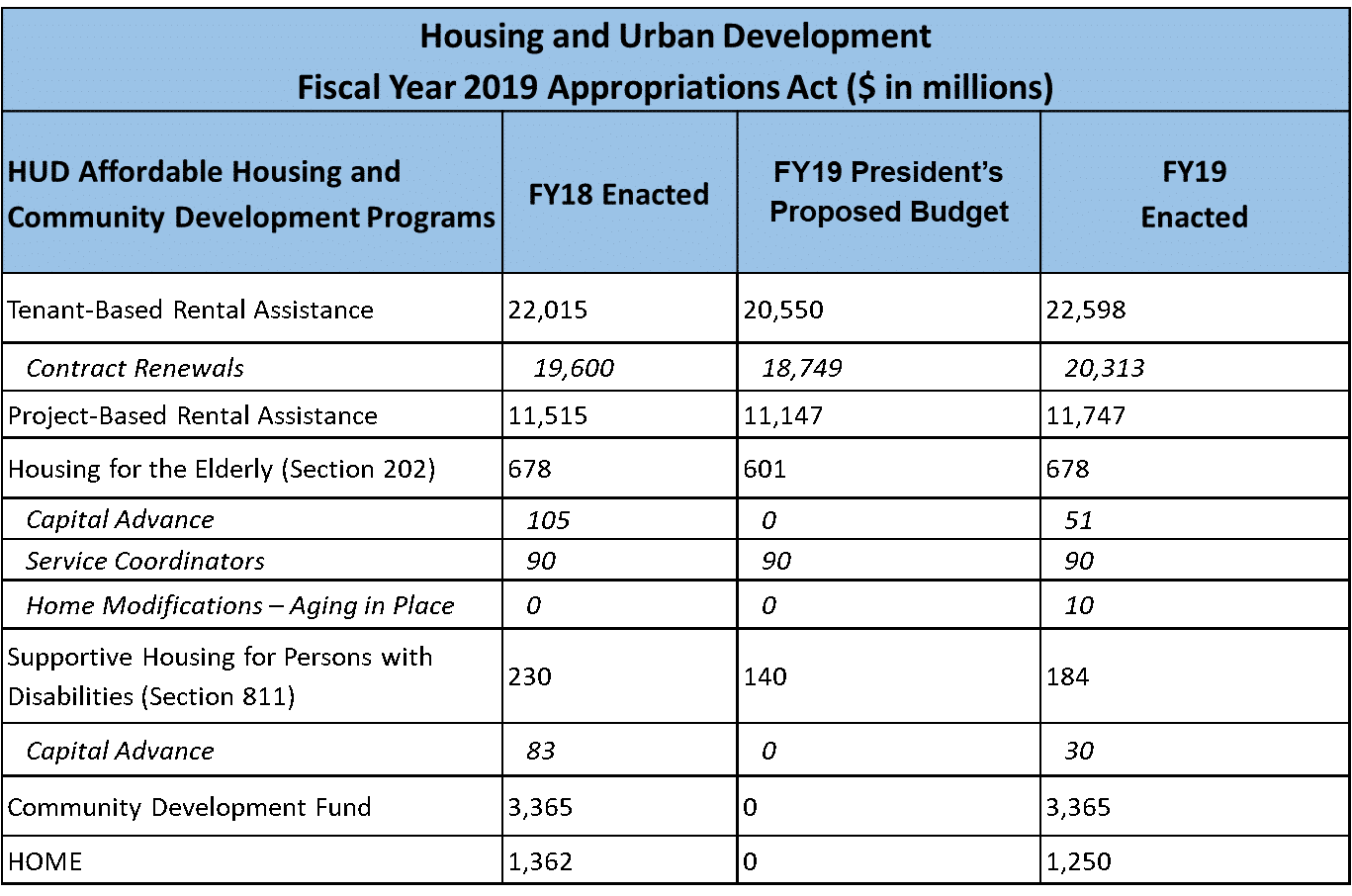
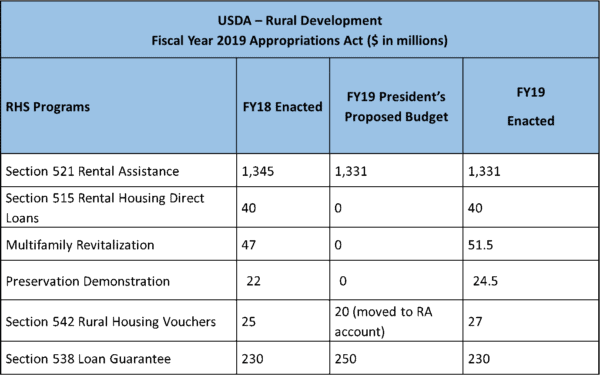
For HUD, the FY19 bill provides $53.8 billion, a $1.02 billion increase from last fiscal year, and over $12.5 billion more than the administration’s FY 2019 request. For USDA Rural Development, the FY19 bill provides mostly flat funding with minimal increases to rural housing programs. In providing increased funding, Congress rejected the administration’s proposed rent reforms to HUD’s rental assistance programs. Congress also rejected the administration’s proposed elimination of several key affordable housing programs, including: Public Housing Capital Fund, Housing Trust Fund, HOME, CDBG, Choice Neighborhoods, and the U.S. Interagency Council on Homelessness.
The FY19 HUD bill also provides notable policy provisions and new program funding, including:
- Housing Choice Voucher (HCV) program – the bill funds a new “Family Mobility Demonstration.” This includes $25 million to implement a voucher mobility demonstration program ($20 million to support PHA programs designed to empower families to successfully move to, and remain in, lower-poverty areas) and up to $5 million for incremental housing vouchers for families with children that participate in the demonstration
- Project-based Rental Assistance (PBRA) program – the bill provides $11.747 billion to renew Project-Based Rental Assistance contracts for the remainder of calendar year 2019
- PBCAs – Congress encourages HUD to work with performance-based contract administrators to identify cost savings while ensuring continuation of all necessary tasks
- Section 202 program – the bill provides $51 million for new capital advances and project-based rental assistance contracts, up to $90 million for service coordinators and the continuation of existing congregate service grants, and $10 million for the new aging in place home modification grant program.
- Section 811 program – the bill provides just over $30 million for new capital advance and project rental assistance awards, and directs HUD to prioritize the creation of new unit configurations that help localities comply with their Olmstead obligations.
- USDA Rural Housing – the bill directs the USDA Secretary to incentivize public housing authorities and nonprofits in preservation activities for their rural rental housing portfolio by allowing these entities to receive a return on investment and an asset management fee up to $7,500 per property.
For additional details, please find the following two charts on HUD and USDA-RD funding levels by program:
Congressional Committee holds oversight hearing on HUD’s handling of government shutdown; HUD leadership calls for technology upgrade
This week, a key congressional Committee heard testimony from top leadership at HUD regarding the more than 1,100 contracts that were allowed to expire during the recent lapse in federal funding. The House Appropriations Subcommittee on Transportation, Housing, and Urban Developments (THUD) called the hearing on “HUD’s Management of Housing Contracts During the Shutdown;” at the time of the hearing on Wednesday, the possibility of another government shutdown still loomed for the end of the week.
NAHMA members and residents from across the country were thrown into uncertainty last month when approximately 1,150 housing contracts in HUD’s Project-Based Rental Assistance (PBRA) and 202/811 housing for the elderly and people with disabilities programs were not renewed during the 35-day government shutdown that ended on January 25, 2019; if available, many affected owners and managers utilized reserve funding – set-aside for critical repairs, such as winter heating systems – to cover regular costs while receiving limited communication from the agency on how to proceed.
Led by Chairman David Price of North Carolina and Ranking Member Mario Diaz-Balart of Florida, the Committee pressed Brian Montgomery, HUD Acting Deputy Secretary, and Irv Dennis, HUD Chief Financial Officer, on their management of housing contracts during the federal funding lapse. In his opening statement, Chairman Price called HUD’s handling of the situation “completely unacceptable,” and questioned the agency’s level of preparedness: “Serious questions have emerged about the Department’s management of the lapse in appropriations—including the degree to which the shutdown was anticipated and whether adequate preparations were made in the preceding weeks. Approximately 650 of [the expired contracts] expired in December, many of them before the lapse in appropriations occurred.”
Mr. Montgomery countered the Committee’s concerns on the expired contracts. “We continued to make contract payments to private owners participating in our Project-Based Rental Assistance program,” said Montgomery. “In cases where payments could not be made, our team worked with owners to find interim solutions, such as accessing property reserves, in order to ensure that residents were not impacted.” Instead, Montgomery maintained that circumstances beyond the agency’s control – including the 97% staff furlough rate and the agency’s 30-year old IT systems – hindered timely contract renewals during the shutdown.
“The biggest frustration we have at HUD is the technology,” Irv Dennis, HUD’s new chief financial officer, said to the Subcommittee Members, many of whom grappled with the complexity of HUD program administration. Dennis and Montgomery described the manual process of mailing and collecting signatures in order to renew contracts as “very dated.” Dennis said, “The number one thing we need is to improve that technology.”
Chairman Price and Ranking Member Diaz-Balart also questioned the agency’s management of stakeholder communication regarding the expired contracts and the shutdown in general. In response, Mr. Montgomery acknowledged that communication should have been handled better during the shutdown, and said the agency has redrafted its contingency plan for an appropriations lapse, which was outdated and included faulty information. Montgomery and Dennis also pointed to the ongoing uncertainty for fiscal year funding as a reason behind ineffective and inadequate management of housing contracts at the agency, calling short-term Continuing Resolutions “extremely difficult” to operate under.
In a subsequent meeting with Chairman Price’s office, NAHMA thanked the Subcommittee members for calling the hearing and continued to push for answers on the agency’s housing contract management and lack of shutdown communication. To watch a recording of the hearing online, please click here. Updates on the government shutdown are available on NAHMA’s shutdown webpage here.
Senate Banking Committee holds Confirmation Hearing for FHFA Director
The week, the Senate Committee on Banking, Housing and Urban Affairs (Banking Committee) held a confirmation hearing for President Trump’s Federal Housing Finance Agency (FHFA) director nominee, Dr. Mark Calabria. Dr. Calabria, who serves as Vice President Mike Pence’s chief economist, was previously the Director of Financial Regulation Studies at the Cato Institute. FHFA is the regulatory agency for Fannie Mae, Freddie Mac, and Federal Home Loan Banks.
In his opening remarks in support of Dr. Calabria’s nomination, Senate Banking Committee Chairman Mike Crapo (R-Idaho) stated, “Dr. Calabria is a leading expert on housing and mortgage finance, and a respected PhD economist…He has nearly 30 years of experience interacting with the housing market from the perspective of academia, government, industry, trade associations, and think tanks…Over the course of his public service career, Dr. Calabria has a long history of working across the aisle to deliver meaningful, lasting reforms.”
Throughout the hearing, Dr. Calabria’s was pressed about past comments on eliminating Fannie and Freddie, as well as their affordable housing goals. However, Dr. Calabria pledged to defer to Congress on housing finance reform, affirmed his support for the 30-year mortgage, expressed support for affordable housing activities in GSEs, and stated that he would not support eliminating the Housing Trust Fund, which is funded by GSEs.
The nomination hearing can be viewed here. NAHMA will keep members up-to-date on the confirmation process.
House Committee examines proposals and barriers to overcoming homelessness
This week, the influential House Financial Services Committee held a hearing on “Homeless in America: Examining the Crisis and Solutions to End Homelessness.” Committee Chairwoman Maxine Waters (D-CA) reiterated her commitment to addressing homelessness, including through legislation to invest more than $13 billion over five years to prevent homelessness by funding new units of affordable housing, new vouchers, case management, and technical assistance.
In her opening remarks, Chairwoman Waters stated, “Today, this Committee convenes for its first hearing of the 116th Congress. This hearing is on an extremely important subject: the national homelessness crisis. Today, there are over a half million people experiencing homelessness nationwide, and nearly 160,000 of them are children. Nearly 38,000 are veterans who we have failed to support after their service to our nation. The number of people experiencing chronic homelessness nationwide increased between 2017 and 2018. In Los Angeles County, there are over 50,000 people experiencing homelessness, nearly 5,000 of whom are children, and over 3,800 of whom are veterans….In the richest country in the world, it is simply unacceptable that we have people living in the streets. This is a top priority for me as Chairwoman.”
During the hearing, the Committee heard testimony from a variety of housing practitioners regarding federal policy, veteran’s homelessness, and work programs; the experts emphasized the need for more data and a coordinated federal effort to prevent and address homeless. Witnesses for the hearing included Ann Marie Oliva of the Corporation for Supportive Services; Nan Roman of National Alliance to end Homelessness; Joshua Stewart of the National Coalition for Homeless Veterans; Justin T. Rush of the True Colors Fund; Carolyn Darley of the National Coalition for the Homeless; and David S. Lucas of the Institute for an Entrepreneurial Society at Syracuse University.
To watch a recording of the hearing and read the draft bills proposed by the Committee, please click here.
Reminder: Plan your March Hill Visits and participate in NAHMA’s Hill Visit Challenge
While in town for the March Meeting, meet with your lawmakers or their staff on Tuesday afternoon to discuss the impacts of affordable housing in your area. NAHMA can assist with scheduling and preparing for meetings. Join our “Hill Visit Workshop” Call on February 19th at 3pm EST to get the latest updates on NAHMA’s housing policy priorities and learn how to have successful meetings on the Hill. Click this link to join via your computer and see our slideshow presentation during the call; you can also use your phone audio by calling the following number: +1 (773) 231 9226, Meeting ID: 148 684 5993.
While on Capitol Hill, you can also join NAHMA’s “March Meeting Hill Visit Challenge.” Participation is easy: Simply snap a photo during your prearranged Hill meeting (or in front of the Congressional office), and send it to jbilowich@nahma.org. Each meeting earns points to help your AHMA win our Challenge bracket! For more information about the Hill Visit Challenge, please click here.