
Affordable housing professionals might encounter a sensitive question: Can an elderly resident’s adult child move in or stay in Department of Housing and Urban Development (HUD) senior housing? The answer is not always a simple yes or no, depending on the HUD regulations and compliance procedures that govern the type of housing program that covers the community. Providing the wrong answer can result in violations, loss of eligibility or even displacement of qualified seniors.
Gwen Volk, president of Gwen Volk INFOCUS Inc., provides answers in a webinar titled “Can My Kid Move In? Understanding Rules for Adult Children in HUD Elderly Housing,” provided in October for SAHMA.
The webinar covers Section 202/8 and 202 Project Assistance Contracts (PAC), Section 202 Project Rental Assistance Contract (PRAC) and Section 8 Elderly-Designated Properties. Each program has its own requirements for what constitutes a household, residential eligibility, and continued occupancy.
HUD elderly housing programs exist to assist seniors and, in some cases, people with disabilities. Allowing adult children without proper oversight can undermine program intent, create compliance risks and block access for eligible applicants. Understanding the rules creates fairness, protects the property and avoids costly mistakes. Volk recommends referring to the HUD Handbook 4350.3 REV-1, specifically chapters 3, 5, and 7, for guidance and best practices.
Adult children aren’t automatically allowed to move in with their parent who resides in HUD-supported elderly housing. The owner/agent can approve the child moving in, but only within the compliance boundaries spelled out in the HUD Handbook. Everything—approvals, relationships and roles—needs to be documented.
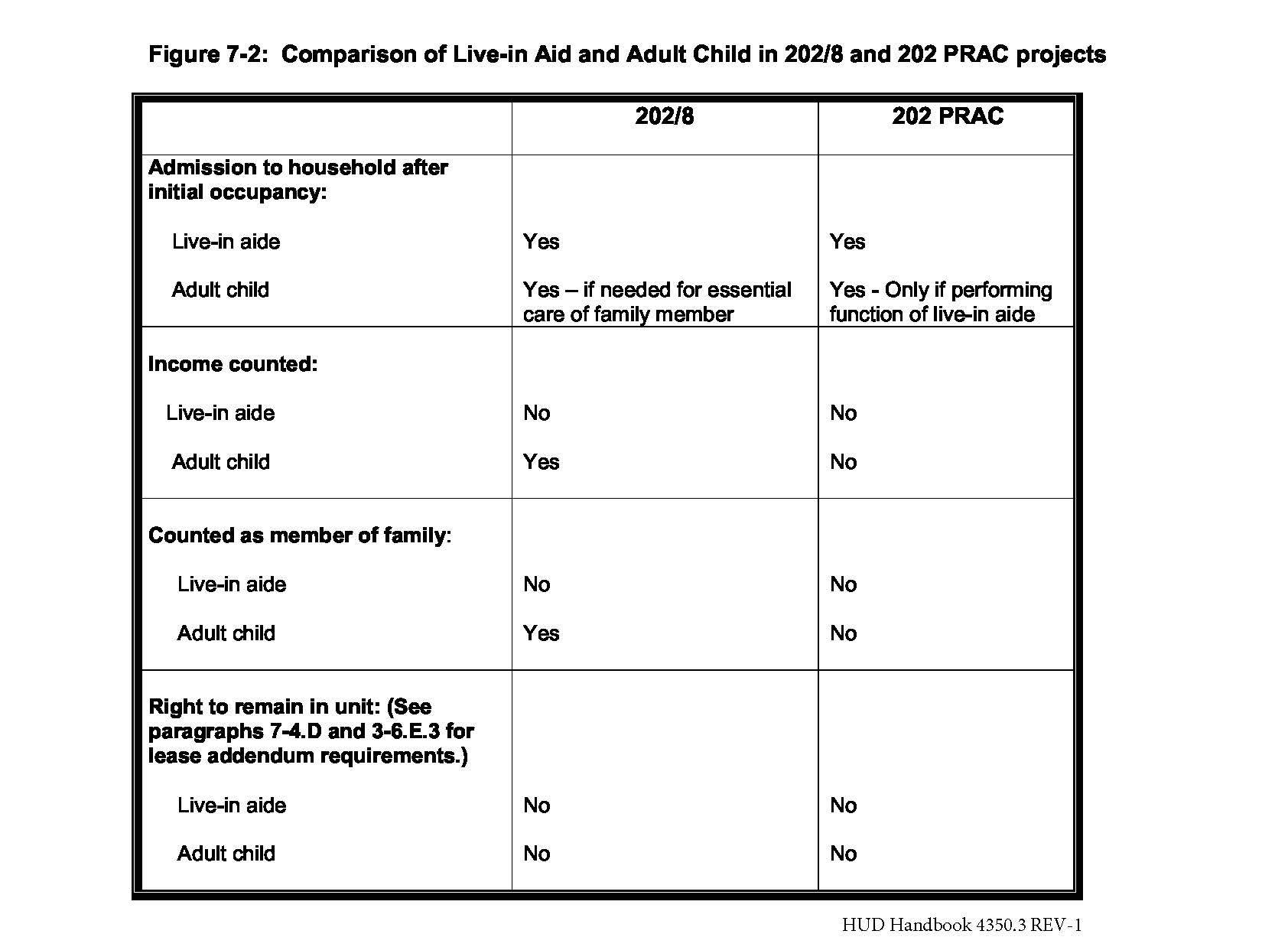
The handbook also makes clear the difference between household members and live-in aides. A household member can include adult children, if approved. They must be on the lease, their income must be counted, and they have residential rights if the qualifying tenant leaves. A live-in aide provides care for the resident. They are not on the lease, their income is not counted, and they have no right to remain after the resident vacates the unit. Live-in aides also can’t bring their own family members to live in the unit without permission.
At initial occupancy, adult children may be included at move-in if disclosed on the application. They are screened and documented. Their presence does not displace an eligible elderly applicant, meaning units are preserved for elderly households and avoid younger adults staying after the elderly parent dies, thereby preventing access for qualified seniors. The adult child can stay and pay rent based on income once the elderly resident leaves or dies.
If an adult child wants to be added after move-in, it requires the owner/agent’s approval and compliance screening. Suppose the child is acting as a live-in aide? In that case, they must meet HUD’s definition of a live-in aide: they must be essential to the resident’s care, not obligated to support the tenant financially, and have no residual rights or ability to add household members.
Additionally, an adult child’s income counts toward the household, and they may remain as a leaseholder if approved as a household member. By contrast, a live-in aide’s income is not counted toward the household, and they must vacate the unit when the resident leaves. For programs such as 202 PRAC, an adult child added later as a live-in aide must also vacate the unit upon the elderly resident’s departure or death.
Best practices for affordable housing professionals include documenting approvals, relationships, and roles. The proper forms and agreements should be used, and informal arrangements should be avoided. Owners/agents should carefully evaluate requests, especially late-stage changes that may signal an intent to remain rather than to provide care, to protect the elderly resident from those who may want to take advantage of them.
Some common scenarios professionals can look out for include an adult child who moves in without approval, which creates a compliance violation; a live-in aide who refuses to vacate, which could require the management to initiate an eviction if necessary; and when adding a family member as a live-in aide after occupancy, which requires medical documentation that an aide is needed.
Sometimes aides, especially relatives, request to become household members when the elderly resident’s health starts to decline. HUD permits denial of the request if the application is inconsistent with the program’s purpose. It may be approved, but it requires a formal written request, screening and income verification, and the timing and intent of the request must align with compliance standards.
Jennifer Jones is the senior director of communications and public relations for NAHMA.