
House Committee Releases Legislation Outlining Over $325B in Housing Investments
This week, the House Financial Services Committee (HFSC) published draft legislation that provides over $325 billion in funding for housing programs. The HFSC bill addresses a wide range of housing issues from alleviating homelessness, increasing new construction affordable housing, rehabilitation/preservation, rental assistance, down-payment assistance, and green building. A breakdown of topline funding levels, by program, is below:
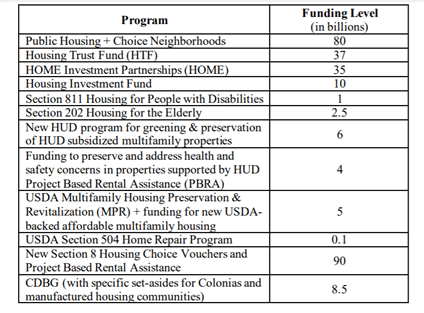
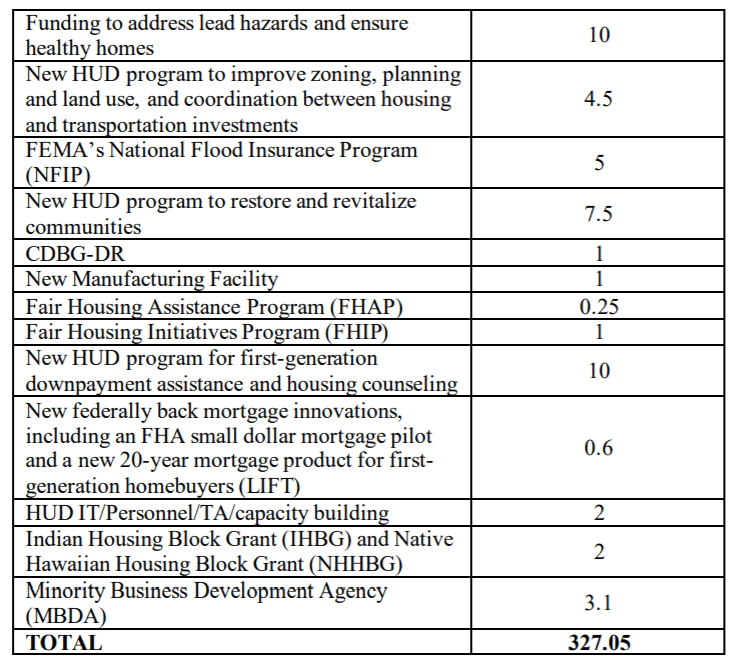
Next week, the HFSC will markup this legislation beginning on Monday, September 13. This legislation will eventually be a part of the larger $3.5 trillion reconciliation package that Congress is considering. Details on the markup is available HERE.
House Holds Hearing Examining Emergency Rental Assistance Reforms
On Friday, the House Financial Services Committee held a hearing titled Protecting Renters During the Pandemic: Reviewing Reforms to Expedite Emergency Rental Assistance, in response to housing advocates, landlords, and grantees having raised concerns about the implementation of the Emergency Rental Assistance (ERA) programs. During the hearing, members heard testimony from housing experts and affordable housing providers who described their concerns and provided examples of problems encountered that slowed the flow of emergency rental assistance, including slow and cumbersome application processes, reluctance of state and local officials and grantees to use less stringent eligibility requirements, and a general lack of awareness form both tenants and housing providers regarding the availability of the emergency funds. The Chairwoman of the Committee, Rep. Maxine Waters (D-CA) and Ranking Member, Patrick McHenry (R-NC), also discussed their individual legislative proposal to reform the ERA programs:
- H.R. 5196, the Expediting Assistance to Renters and Landlords Act of 2021 introduced by Chairwoman Waters, would make several changes to the ERA 1 and ERA 2, including requiring allowing landlords to directly apply for back rent after providing notice to their tenants that they intend to apply, and conditioning the federal assistance the landlord receives on specific requirements, such as the tenant being able to remain stably housed for at least 120 days after receiving the assistance, with specific exceptions related to health and safety of other individuals or property damage, to which the landlord can apply for rent payments to cover the 120 days. Other provisions include requiring grantees to accept self-attestation of a tenant and providing safe harbor provisions for grantees.
- H.R. 3913, the Renter Protection Act of 2021 introduced in June by Ranking Member McHenry, would require transferring all allocated but undisbursed ERA 2 program funds into the ERA 1 program, and Treasury would be required to disburse the funds within 30 days. It would also mandate grantees with any unused ERA funds after July 1, 2021, to use those funds exclusively to pay off rental arrears eligible households but not to provide prospective rent payments.
To view the full committee hearing, click here.
Administration Encourages Greater Action on ERA Delivery
This week, the Administration hosted state and local leaders who have demonstrated efficient and rapid delivery of emergency rental assistance and enacted policies and procedures that helped avoid evictions for non-payment of rent. Secretary of the Treasury, Janet Yellen, highlighted the importance of preventing evictions and made clear that Treasury has and will continue to remove any red tape that creates unnecessary, burdensome documentation processes and encouraged self-attestation for financial hardship, income, and homelessness. She also reiterated that Treasury is prepared to reallocate funds from state and local grantees that have failed to quickly disperse emergency rental assistance funds to those grantees that are efficiently getting the funds out.
Secretary Yellen reported that slightly more than $5 billion in rental assistance has gone into the hands of those who need it as of July 30, and White House American Rescue Plan (ARP) coordinator, Gene Sperling reported that the Administration’s goal of getting $16 billion of Emergency Rental Assistance program (ERA 1) funding out to tenants and housing providers in the next couple months would not be met. Instead, at the current pace, he believes that only about $8 billion will go out by the end of October. The Administration acknowledged the bottlenecks that are being experienced all over the country and are actively working to provide further guidance and assistance to state and local grantees and will continue to promote the all-of-government effort to prevent evictions and get funding out faster. The Administration highlighted Treasury’s Promising Practices that cities and localities are using to speed u assistance delivery.
The meeting focused on best practices and included examples of high performing emergency rental programs, that involved:
- Virginia Governor Ralph Northam, who discussed how his states emergency rental relief programs utilized fact-specific proxies for low-income zip codes, pre-qualifying households accessing assistance programs, allowing for self-certification, and using ARP funds to provide legal assistance, allowed Virginia to lead the country in distribution of the ERA 1 funding.
- Louisville Mayor Greg Fisher, who described how a streamlined application process, combined with self-certification flexible documentation requirements and fact-based proxies allowed his city to spend all the ERA 1 funds by the end of July.
- Judge Lina hidalgo, from Harris County, Texas, and San Antonio Mayor Ron Nirenberg, both discussed how the usage of a proactive eviction diversion strategy that included efforts to reach out to tenants on the eviction docket and connect them with rental assistance, allowed Harris County and San Antonio to both get 92% of ERA 1 funds out by the end of July. They also shared how the use of self-attestation and more streamlined application processes helped disburse funds faster.
To view a recording of the discussion, click here.