
Highlights from the 2023 GAP Report
The National Low Income Housing Coalition (NLIHC) has published their annual Gap Report (the Report), which measures the availability of rental housing affordable to extremely low-income households and other income groups. It also examines the demographics, disability and work status, and other characteristics of the extremely low-income households most impacted by the national shortage of affordable and available rental homes and presents data on the affordable housing supply and housing cost burdens at the national, state, and metropolitan levels. The Gap Report is based on the American Community Survey Public Use Microdata Sample. Below are highlights from the Report.
Shortage of Housing Continues
Between January 2021 and December 2022, rental prices increased 22% nationally and were not confined to certain markets. The shortage of affordable and available rental homes for extremely low-income renters worsened by more than 500,000 units, increasing from a shortage of 6.8 million to 7.3 million. The Report found that only 33 affordable and available rental homes exist for every 100 extremely low-income renter households and extremely low-income renters face a shortage in every state and major metropolitan area. This is a troubling decrease, as last year’s report indicated that only 37 homes were available for every 100 extremely low-income households.
Increase of Extremely Low-Income Renters
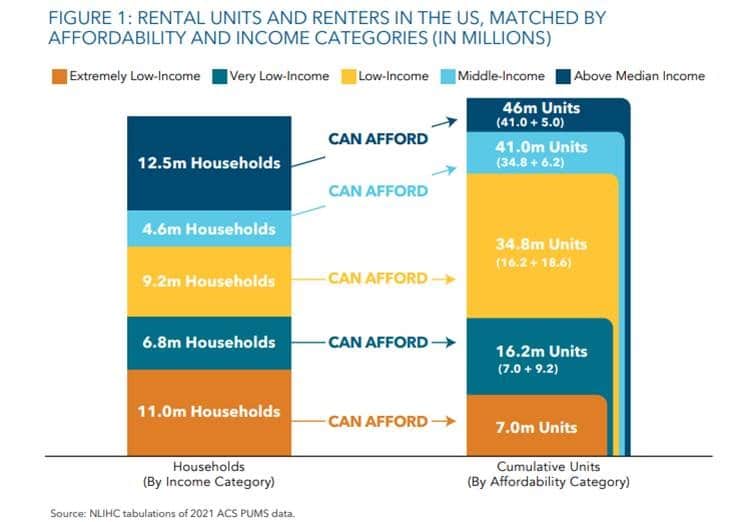
Out of about 44.1 million renter households in the U.S., 11 million have extremely low incomes, or incomes at or below either the federal poverty guideline or 30% of the area median income (AMI), whichever is higher. Income losses due to the pandemic, followed by significant increases in rental prices, resulted in 200,000 new households becoming extremely low-income, as well as in a decrease in the number of units affordable to them. The Report found that only 7.0 million units are affordable to extremely low-income renters nationally. This supply leaves an absolute shortage of 4.0 million affordable rental homes and extremely low-income renters are the only income group to face this absolute shortage of affordable homes; for all other income groups, there are enough affordable rental units to accommodate all households (see Figure 1 below which illustrates the mismatch between the number of households within an income bracket and the number of affordable rental homes).
Renter Demographics
Forty-eight percent of renter householders with extremely low incomes are seniors or householders with disabilities, 42% are in the labor force, in school, or single-adult caregivers. In terms of demographics, nineteen percent of Black households, 17% of American Indian or Alaska Native households, and 14% of Latino households are extremely low-income renters, compared to 6% of white households.
Policy Recommendations
The Report’s recommendations include further federal investments to preserve and expand the stock of deeply affordable housing, expanding housing vouchers to all eligible households, investing in a housing stabilization program that provides renters with emergency funds when they experience unexpected financial shocks, and strengthening and enforcing renter protections. The Report concludes that any reduction in federal affordable housing resources will only exacerbate the existing shortage, which is already acute.
A more detailed NAHMAnalysis on the 2023 GAP Report will be forthcoming.