
House Releases FY24 THUD Funding Bill
This week, the House of Representatives’ Committee on Appropriations released the fiscal year (FY) 2024 draft Transportation, Housing, and Urban Development (THUD) funding bill. The legislation proposes funding HUD at $65.208 billion in fiscal year (FY) 2024, which the House Committee on Appropriations says is 25% below FY23 funding. It would cut funding for many HUD programs while eliminating funding for others. Below is a breakdown of key HUD rental assistance programs with proposed funding levels for FY24:
Proposed Funding for HUD Programs
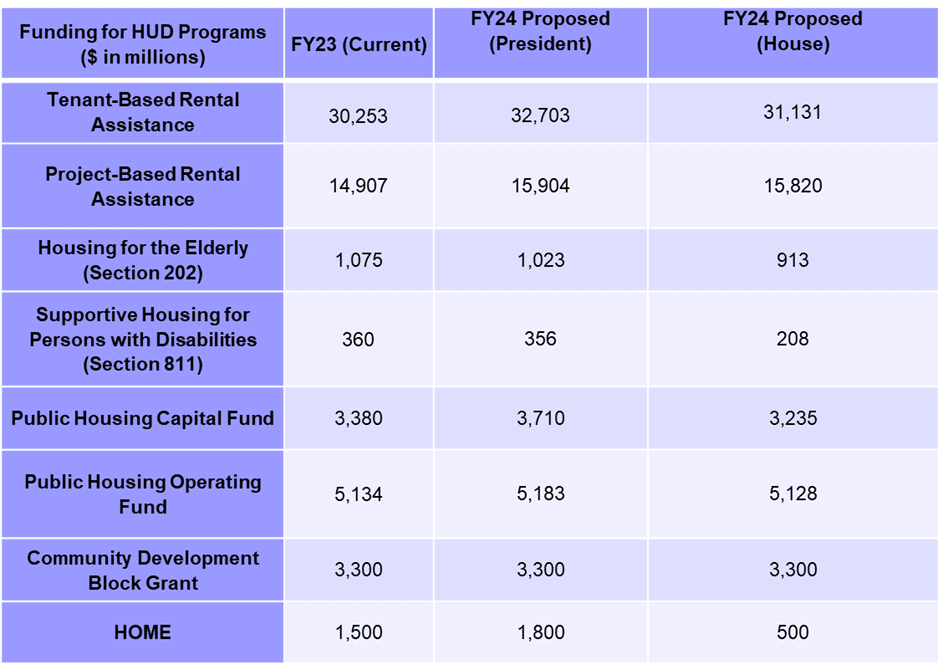
TBRA–The House bill requests $31.131 billion for Tenant-Based Rental Assistance (TBRA), which is almost $1 billion more than the FY23 current level. This includes:
- $27.3 billion for Contract Renewals, which is an increase of $973 million from the 2023 levels;
- $2.7 billion in Administrative Fees, a decrease of roughly $500 million;
- $337 million for Tenant Protection Vouchers, which is a decrease of $48 million;
- $686 million for Section 811 Mainstream Renewals, which is an increase of $79.5 million;
- Funding for Mobility Services and Incremental Vouchers was not included.
PBRA–The legislation requests $15.8 billion for the Project-Based Rental Assistance (PBRA) program, which is $913 million more than the 2023 current level. This includes:
- $15.4 billion for contract renewals and amendments
- $448 million for Performance-Based Contract Administration (PBCA).
Section 202– The House bill includes $913 million for the Section 202 Housing for the Elderly program, a decrease of $162 million from FY23. This includes:
- $770 million to fund renewals and amendments of Project Rental Assistance Contracts (PRACs) and Senior Preservation Rental Assistance Contracts (SPRACs). For FY23, HUD has said that $797 million is necessary to renew PRAC subsidies.
- Up to $25 million for new intergenerational housing;
- Up to $112 million to fund the renewal of approximately 1,600 existing Service Coordinator and Congregate Housing Services grants; and
- $6 million for administrative and other related expenses.
It is not yet clear how many families and residents who rely on Section 202 assistance would be impacted by the proposed cuts.
Section 811– The House bill requests $208 million for the Housing for Persons with Disabilities account, which is $152 million less than the 2023 current level. At this time, it is unclear if this amount would cover the renewal and amendment costs for PRACs, Project Assistance Contract (PAC), and State Project Rental Assistance (State PRA).
HOME Program— The bill provides $500 million for the HOME Investments Partnerships Program, which is $1 billion less than the current 2023 level.
Public Housing— The House bill requests $8.363 billion for the Public Housing Fund, which is $150 million below the FY23 enacted level and $530 million below the President’s Budget Request. It provides $3.2 billion to public housing capital needs, a decrease from the $3.3 billion provided in FY23. This assistance includes formula funding and $40 million for emergency capital needs. Of that amount, the bill specifies that at least $20 million must be used for safety and security measures in public housing. The bill would provide $5.1 billion for public housing operating costs, a slight decrease from current FY23 funding. Operating support includes both formula funding and an additional $25 million, to be allocated based on need. The bill also provides $175 million for the Family Self-Sufficiency Program.
Fair Housing— The bill proposes legislative language that would ban the use of FY23 funding to “implement, administer, or enforce” the Affirmatively Furthering Fair Housing (AFFH) rule, or from using funds to direct grantees to undertake specific changes to existing zoning laws to carry out the interim final rule, “Restoring Affirmatively Furthering Fair Housing Definitions and Certifications.”
Healthy Homes—The House bill provides $345 million for the Office of Lead Hazard Control and Healthy Homes, which is $65 million below the FY23 current level and the President’s Budget Request.
In a March letter to Rep. Rosa DeLauro (D-CT), the Ranking Member of the House Appropriations Committee, HUD Secretary Marcia Fudge stated that if funding cuts proposed by the House are enacted, over one million households would lose their rental assistance and that such extreme funding cuts would also make it impossible for HUD to stave off mass evictions. Given the funding reductions proposed by the House, NAHMA will continue to advocate with lawmakers to ensure they work together to provide at least level funding for HUD programs in FY24.
To view a summary of the bill, click here. To view the full bill text, click here.
HUD Represented the United States at the G7 Sustainable Urban Ministers’ Meeting
HUD Secretary Marcia Fudge traveled to Takamatsu, Japan last week to attend the G7 Sustainable Urban Ministers’ Meeting on July 8th and 9th. Leading the U.S. Delegation, Sec. Fudge met with global leaders in housing, infrastructure, and city planning and the conversations focused on best practices for creating sustainable urban communities. The meeting included dedicated sessions focusing on carbon-neutral cities, inclusivity, and digitalization. Both Secretary Fudge and HUD Deputy Assistant Secretary for Research, Evaluation and Monitoring Dr. Calvin Johnson provided comments during the meeting.
At the meeting, Secretary Fudge signed a Memorandum of Cooperation (MOC) with Japanese leaders in housing and urban development designed to strengthen the relationship between the United States and Japan in this field. The MOC establishes a plan for collaborative research and the exchange of ideas regarding issues like innovative housing policy, inclusive urban planning strategies, and best practices for the implementation of carbon neutrality and climate resilience in cities.
To view press release, click here.