
Treasury Provides Update to Emergency Rental Assistance Programs
The Department of Treasury recently published an update on the Emergency Rental Assistance Programs (ERA 1 and ERA 2) and reported that state and local governments had provided $2.19 billion in assistance to more than 521,000 renters and property owners in October 2021. However, it’s important to note that October was the first month where the distribution of funds did not increase, but rather decreased from the previous month (see chart below). In total, approximately $13.1 billion, or 54.3 percent of ERA 1 funds have been disbursed to struggling households as of October 31, 2021. Treasury now projects that approximately $25 to $30 billion of combined ERA 1 and ERA 2 funds will be spent or obligated by the end of the year. For ERA 1 alone, Treasury estimates that at least 80% of the program’s funding will be spent or obligated by year-end, nine months before the deadline for grantees to spend their initial allocations. As of the end of October, more than 100 State and local ERA 1 grantees had expenditure ratios of 95% or more, meaning they had effectively completed spending ERA 1 funds, and nearly 130 grantees had already begun to spend their ERA 2 funds.
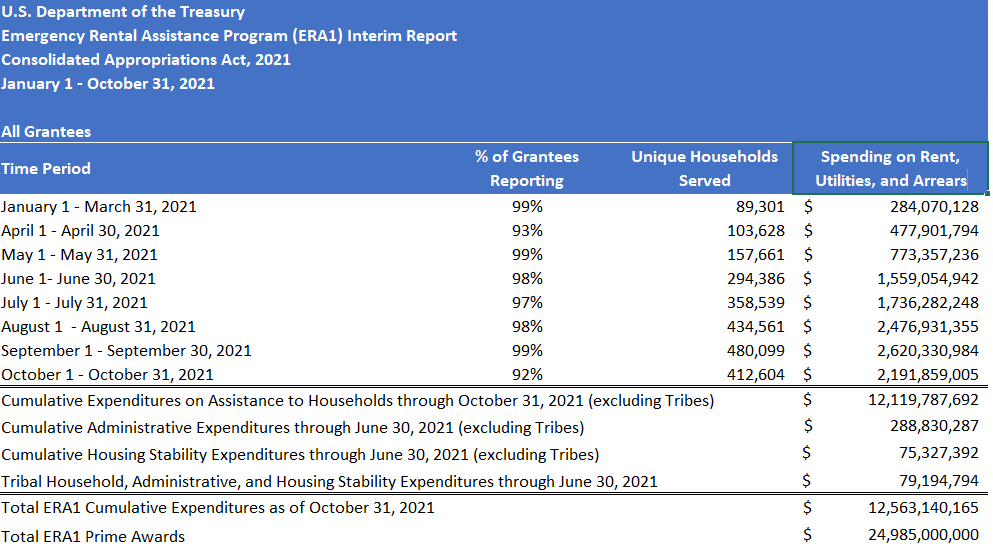 (Source: U.S. Department of Treasury October 2021 Rental Assistance Date)
Treasury also reported that numerous grantees have announced that they have obligated most of their ERA 2 funding. Additionally, Treasury has begun a process to reallocate available ERA 1 funds from grantees that have unused funds. Treasury anticipates that a substantial portion of the first round of reallocation will happen voluntarily – in a collaborative process among grantees and Treasury. Due to improvement in ERA programs, including the overwhelming share of funds estimated to be spent or obligated by year-end, Treasury expects only a limited amount will be available for reallocation. Treasury is encouraging states and localities to use other sources of funds, including the $350 billion Coronavirus State and Local Fiscal Recovery Funds, to provide additional support to renters, and continues to provide grantees with additional flexibilities and best practices that help speed up the pace at which these funds are reaching renters and property owners in need.
FinCEN Seeks Comments on Proposed Real Estate Sector Reporting Requirements
This week, the Financial Crimes Enforcement Network (FinCEN) issued an advance notice of proposed rulemaking (ANPRM) seeking public comment on potential real estate reporting requirements. According to the ANPRM that was published on December 6, 2021, FinCEN is soliciting comments on the approach it should take with respect to potential Bank Secrecy Act information collection and reporting requirements when entities participate in transactions involving non-financed purchases of real estate. Specifically, FinCEN is seeking to address systematic money laundering vulnerabilities in the U.S. real estate sector and to combat the ability of illicit actors to purchase real estate without involving loans or other financing by regulated financial institutions. Money laundering vulnerabilities threatens U.S. national security and the integrity of the financial system and FinCEN is considering how best to focus its regulatory attention on residential and commercial real estate transactions. FinCEN has noted that money laundering risks stem from transactions in both the commercial and residential real estate sectors, and both merit appropriate regulatory treatment. FinCEN recognizes the need to develop a rule that obtains information needed to assist law enforcement and prevent illicit finance in a way that strives to minimize the burden on reporting companies. This ANPRM is the first step in the rulemaking process to address money laundering concerns and to consider ways to maximize benefits while minimizing burdens on reporting financial institutions and nonfinancial trades or businesses. “Increasing transparency in the real estate sector will curb the ability of corrupt officials and criminals to launder the proceeds of their ill-gotten gains through the U.S. real estate market,” said Himamauli Das, Acting Director of FinCEN. “Addressing this risk will strengthen U.S. national security and help protect the integrity of the U.S. financial system. We urge stakeholders to provide input to assist us in developing an approach that enhances transparency while minimizing burden on business.”
To view the Advance Notice of Rulemaking seeking public comment, click here.
To view the FinCEN press release, click here.